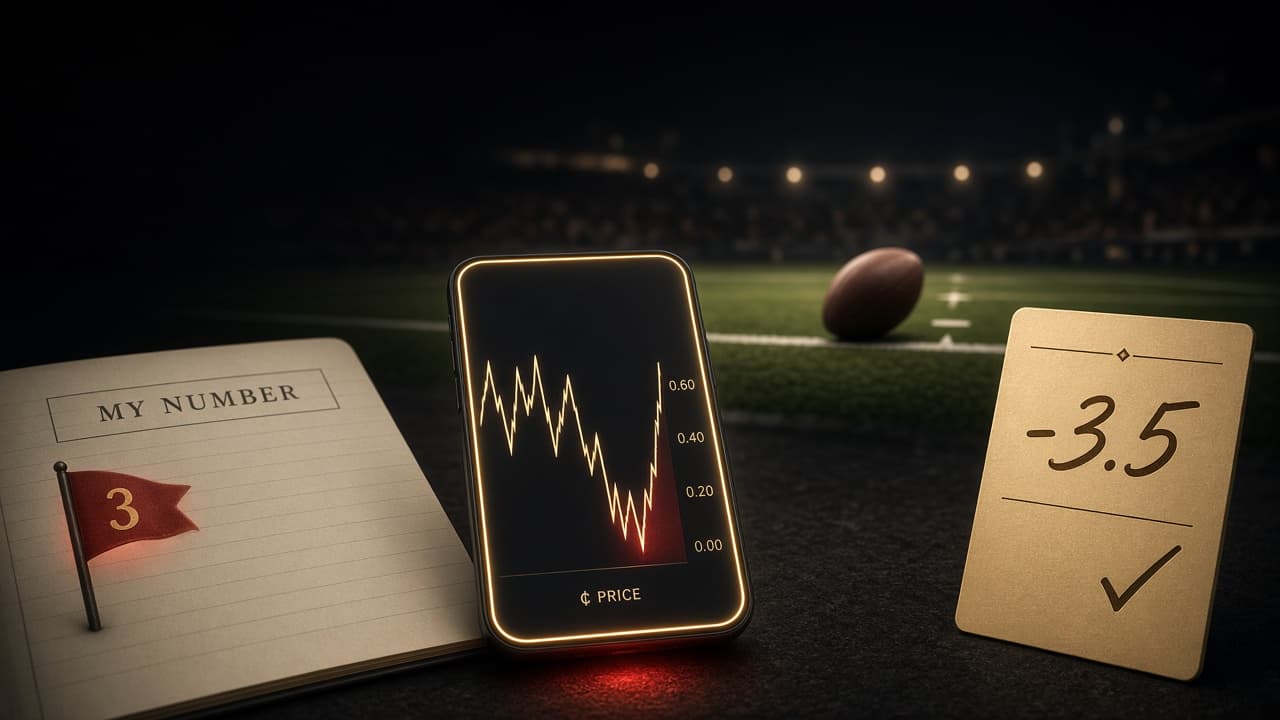
Part 3 of "7 Red Flags in Your Betting Style a Betting Journal Can Catch."
Red flag #3 is putting real money on a game you never priced. If you can't write down your own number before you see the line, you don't have a bet. You have a hunch with a price tag on it. I know because I just paid for one.
How did I end up betting Tulsa?
Tulsa was at home against North Texas, and I had no real reason to like them. I don't watch that conference. I watch SEC and Big Ten. What I had was a couple of box scores rattling around in my head, which is just recency bias wearing a jersey, and College GameDay chirping "Tulsa" in the background until I'd talked myself into it.
My fantasy-style math said they'd win by 14. That number didn't come from scouting. It came from vibes I'd dressed up as math.
What does a bet without a number feel like in the fourth quarter?
Down a touchdown in the fourth, no ball, and my position was trading around 20 cents. Then North Texas scored in three plays to go up 31-17. Tulsa clawed back to within a point, and the coach went for two instead of overtime. Replay said they came up an inch short.
I watched the odds flip back and forth on Robinhood the entire time. That's the tell. When you have a number, you know why you're in the game. When you don't, you're just watching a price chart and hoping.
Why does this matter if I'm winning?
I went 10-6 on the NFL. Good record. But a record hides things. Some of those wins came on games I had no business betting, because I hadn't done the scouting. Being right without a reason isn't a skill. It's a loan, and the bill comes due.
This is why I built BetSharper to grade the decision, not the scoreboard. Once my leans were in the app, the pattern was obvious: my AFC leans outperform my NFC leans by leaps and bounds.
As a Vikings fan, that stung. I got burned buying the LA hype on the Chargers and the Rams. I've been right on the Browns, right on New England, right shorting the Jets. The exception is Houston. I'm 0-for-4 on Houston. So the rule writes itself: I don't bet Houston.
What happens when you ignore your own data?
This week, I liked Jacksonville to cover. I really wanted Jacksonville at Cincinnati, and I couldn't pull the trigger. Instead I bet an NFC game, the side of the board my own numbers tell me to stay away from, and lost.
The kicker: my pre-flop AFC pick, locked Tuesday before the line moved, had closing-line value. I priced it right, and then I didn't bet it. The journal didn't just catch a bad bet. It caught me betting against my own edge.
What does rigor look like before real money goes in?
Here's the opposite of Tulsa. I went in heavy on Atlanta at New Orleans at 46 cents. That wasn't a GameDay hunch. I'd watched four weeks of tape: Penix, Cooper Rush, a massive offensive line, and a two-headed running back. On the other side, the Saints can't stop anyone. The Lions beat them. And the way I read it, the Lions defense after Carolina is about as bad as I've seen in 50 years.
That's a number I can defend. I fed all of it into the app, and that's the point. Now when I get the prime-time hankering, say Goff at the Ravens on a night I haven't done the work, the journal reminds me what my unscouted bets look like. So I sit on my hands, and that's how the leakage stops.
How do you catch this red flag in your own betting?
- Write your number before you see the line. If you can't produce one, tag the game WATCH or PASS, not BET.
- Only bet teams you've actually scouted. For me that's SEC, Big Ten, and the NFL teams I track every week.
- Split your record by category. Conference, AFC vs. NFC, favorite vs. dog. Your leaks hide inside the totals.
- Make "don't bet" rules from your data. Mine is Houston. Yours is in your journal.
- Grade against the close, not the final score. CLV tells you whether your process is real, even in the weeks the ball bounces wrong.
Lock your number before you see the line and let BetSharper grade your judgment, not your luck. Start your journal at betsharper.ai.
Common questions
What does betting without a number mean? It means putting money on a game before you've set your own price for it. If you can't say what you think the spread should be, you can't know whether the line is giving you value.
How does a betting journal help with recency bias? Writing your number down before you see the line, then grading it against the close, shows whether you were actually pricing the game or just reacting to last week's box score.
Should I only bet games I watch? It's a good rule of thumb. If you haven't scouted a team, you probably can't price them, and a journal will usually show those games are where your results leak.
21+ (18+ where permitted). Gambling problem? Call 1-800-MY-RESET (or 1-800-GAMBLER) · ncpgambling.org. BetSharper is a journal for your own numbers. It doesn't take bets and doesn't promise results.